

Last Updated on June 27, 2024
Getting to the Heart of Art and the Sublime
What is the sublime in art?
The sublime, with its power to evoke awe and terror, has ignited the imagination of philosophers and artists for centuries, pushing the boundaries of human experience and artistic expression.
The sublime, as defined by philosophers like Edmund Burke and Immanuel Kant, evokes feelings of awe, terror, and grandeur, transcending ordinary beauty and touching the profound aspects of existence. In the realm of art, the sublime is often associated with the ability to provoke deep emotional responses and elevate the viewer beyond the mundane.
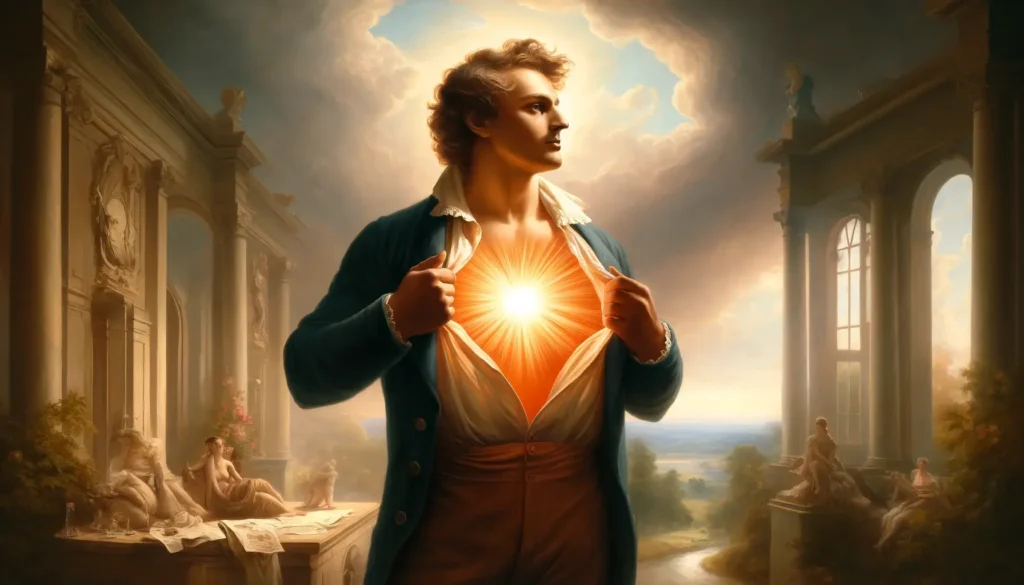
The sublime, as it relates to art, involves the depiction of scenes or ideas that challenge our perceptions and inspires a sense of vastness or power that is beyond our comprehension. This can be achieved, for example, through the immense scale of a landscape painting, the overwhelming realism represented in a sculpture, or the abstract concepts explored in conceptual art.
In my own article, “Conceptual Art: Why It Works and How It Fails,” I list the sublime as a key component to judge the ultimate success of an artwork. The ability of an artwork to reach or attempt to reach the sublime is fundamental in how we evaluate its impact and significance. This criterion underscores the importance of engaging with art on a deeper emotional and intellectual level, resonating with Kant’s exploration of art and the sublime.
Immanuel Kant, the eminent 18th-century philosopher, played a crucial role in articulating a framework for understanding the sublime that continues to influence contemporary art practices. Kant’s theories on the sublime offer a profound way to engage with art, emphasizing emotions that transcend ordinary beauty and touch the depths of human experience.
This article aims to explore how Kant’s philosophy of the sublime has shaped contemporary art, examining specific artworks that evoke feelings of awe, terror, and grandeur. By understanding the theoretical underpinnings of the sublime and its practical applications in art, we can gain deeper insights into the power and purpose of artistic expression today.
Kant and the Sublime: Understanding His Influence on Aesthetics
We start with Kant on art and the sublime because his philosophy fundamentally shapes our understanding of art’s ability to profoundly influence emotional and intellectual responses.

Immanuel Kant is widely recognized for his contributions to various fields of philosophy, including metaphysics, epistemology, ethics, and aesthetics. Kant’s emphasis on the importance of rationality, moral autonomy, and the pursuit of knowledge within the bounds of human cognition reflects the Enlightenment ideals of intellectual progress and individual empowerment.
Kant is perhaps best known for his critical philosophy, particularly his “Critique” series, which includes the “Critique of Pure Reason,” “Critique of Practical Reason,” and “Critique of Judgment.” These works collectively explore the limits and capacities of human knowledge, the foundations of moral law, and the principles of aesthetic judgment.
Kant posits that for an artwork to be considered fine art, it must follow the established rules and conventions of art, such as representation, skill in perspective, color, and form. These formal properties are essential for creating a work that can be universally recognized and appreciated.
However, Kant argues that these elements alone are insufficient to define true beauty in art. He asserts that beauty cannot be purely derived from adherence to rules; it requires something more—an intrinsic quality that resonates with the viewer on a deeper level.

This intrinsic quality, according to Kant, is the product of genius. True works of art that represent beauty are the creations of individuals who possess a unique capacity to express harmony and beauty beyond what can be taught or replicated through skill and knowledge alone. Artistic genius involves the ability to access higher reason and perception, allowing the artist to produce works that evoke the “free play of the senses” and engage the viewer’s imagination and understanding in a harmonious interaction.
In the “Critique of Judgment” (1790), Kant distinguishes between the beautiful and the sublime, offering a detailed analysis that has significantly influenced aesthetic theory. For Kant, beauty is associated with harmonious form and proportion, evoking pleasure and admiration. Beauty is tied to the perception of purposiveness without purpose, meaning that we find something beautiful when its form appears to be designed for our appreciation, even though it serves no practical function.
“Beauty is the form of the purposiveness of an object, so far as this is perceived in it without any representation of a purpose.”
Immanuel Kant, Critique of Judgment, §17
Kant emphasizes that this free play is crucial for experiencing beauty. It involves a dynamic interplay between the sensory input from the artwork and the cognitive faculties of the viewer, creating a sense of pleasure and appreciation that transcends mere technical perfection. This process is what enables art to evoke profound emotional and intellectual responses, elevating it to the realm of fine art.
The sublime, however, is an overwhelming experience often linked to nature’s vastness and power, invoking a mix of awe and terror. Kant categorizes the sublime into two types: the mathematical sublime and the dynamic sublime.
The mathematical sublime arises when we encounter something of immense size or quantity that defies our ability to comprehend it fully, such as the vastness of the universe or the endless expanse of the ocean. The dynamic sublime, on the other hand, is experienced in the face of nature’s immense power and force, such as thunderous storms, towering mountains, or raging seas. These phenomena evoke a sense of terror mixed with admiration, reminding us of nature’s uncontrollable might.
“We call that sublime which is absolutely great. In the estimation of the magnitude of natural things, the sublime is that in comparison with which all else is small.”
Immanuel Kant, Critique of Judgment, §25
Kant believed that the sublime challenges our sensory limits and rational faculties, pushing us to grapple with infinity and the boundlessness of nature. This encounter with the sublime elevates our mind, highlighting both the limitations and the capabilities of human perception and reason. By addressing these profound experiences, Kant’s work on the sublime offers a deeper understanding of how humans engage with art and nature on an emotional and intellectual level.
Kant’s exploration of the sublime in the “Critique of Judgment” is central to his aesthetic philosophy, providing a detailed framework for how humans experience and judge art and natural phenomena. His distinctions between the beautiful and the sublime ground his discussion in a broader context of aesthetics, emphasizing the powerful and often overwhelming emotional responses that art and nature can evoke. This theoretical foundation continues to influence contemporary art practices, shaping how artists create and how viewers engage with works that aspire to evoke the sublime.
Art and the Sublime in Contemporary Practice
Contemporary art continues to explore and expand on the concept of art and the sublime, often incorporating elements of awe, terror, and grandeur to provoke deep emotional and intellectual responses. Artists today use various mediums and techniques to evoke the sublime, sometimes through scale, complexity, or themes that confront the viewer with existential questions.
James Turrell: Playing with Perception
James Turrell, a renowned contemporary artist, creates immersive light installations that evoke the sublime by altering our perception of space and light. His work, such as the Roden Crater project, transforms natural landscapes into otherworldly experiences.
Roden Crater, located in the Painted Desert region of Northern Arizona, is an unprecedented large-scale artwork created by light and space artist James Turrell within a volcanic cinder cone. This monumental project, which Turrell has been developing since 1977, represents the culmination of his lifelong research into human visual and psychological perception.
Designed as a controlled environment for experiencing and contemplating light, Roden Crater requires visitors to embark on a journey into the remote desert, offering an unparalleled experience of the vast, dark night skies.
From the outside, the Roden Crater looks like a naturally occurring mound in the landscape. However, underneath the mound are 23 uniquely engineered spaces designed for viewers to enter and experience Turrell’s light installations. These installations are inspired by geologic and celestial cycles, allowing viewers to engage directly with larger-than-life concepts, making Roden Crater a pinnacle of American landscape art and a true phenomenon in the world of art.
Turrell’s work at Roden Crater exemplifies the concept of the sublime as articulated by Immanuel Kant, where the vastness and power of nature evoke profound emotional responses. Roden Crater’s remote location and its immersive experience of light and celestial events embody the mathematical and dynamic sublime, challenging our sensory limits and pushing us to confront infinity and the boundlessness of nature.
This aligns with Kant’s exploration of art and the sublime, which emphasizes the emotional and intellectual engagement that transcends ordinary beauty. By transforming the natural landscape into a site for the contemplation of light and time, Turrell’s Roden Crater continues to shape contemporary art practices, offering a transformative sensory experience that links the physical with the ephemeral, resonating deeply with the philosophical foundations of the sublime.
Bill Viola: The Sublime in Video Art
Bill Viola, a contemporary video artist, creates works that evoke the sublime through immersive and emotionally intense video installations. His pieces often focus on themes of life, death, and transcendence, using slow motion, water, and light to create profound sensory experiences. One notable example is “The Crossing” (1996), a video installation that features a man walking towards the viewer, ultimately engulfed by fire in one version and water in another.
Viola’s work captures the essence of the dynamic sublime as described by Immanuel Kant, where the viewer is confronted with powerful natural elements—fire and water—that evoke a mixture of awe, terror, and contemplation.
The slow, deliberate pace of the videos amplifies the emotional impact, allowing viewers to fully engage with the overwhelming power and beauty of these natural forces. This confrontation with the elements in a controlled, meditative context challenges the viewer’s perceptions and evokes a deep, reflective response.
Unlike monumental sculptures or vast landscapes, Viola’s installations achieve the harmony of art and the sublime through the manipulation of time, space, and sensory experience. His work demonstrates that the sublime can be found in the intensity of the moment and the depth of emotional engagement, rather than sheer physical scale.
Refik Anadol: The Digital Sublime in the Age of Technology
In the digital age, artists like Refik Anadol are pioneering new ways to evoke the sublime through the use of advanced technology. Anadol’s work often involves data-driven installations that challenge and expand the boundaries of human perception. One of his most notable projects, “Machine Hallucination,” uses artificial intelligence to generate immersive environments that seamlessly blend reality and fantasy.
“Machine Hallucination” is an innovative exploration of how vast amounts of data can be transformed into visual art. Anadol processes millions of images and data points to create a dynamic, ever-changing visual experience. These digital landscapes, characterized by their infinite complexity and fluid forms, push the viewer to confront the limits of their cognitive and perceptual capabilities. This experience mirrors the Kantian concept of the sublime, where the sheer scale and complexity of what is perceived can overwhelm the senses and evoke a sense of awe and wonder.
The installation immerses viewers in a constantly shifting environment that feels both familiar and alien. The use of AI to manipulate data in real-time creates a sense of boundlessness, as digital formations continuously evolve and transform. This challenges viewers to grapple with the enormity and unpredictability of the digital sublime, echoing Kant’s idea that the sublime confronts us with the infinite and the overwhelming power of nature, or in this case, the digital universe.
Conclusion: Embracing the Sublime in Art
The exploration of art and the sublime, as articulated by Immanuel Kant and other philosophers, continues to shape the landscape of contemporary artistic practice. From the monumental and immersive environments of James Turrell’s Roden Crater to the intense, meditative experiences in Bill Viola’s video art, and the boundary-pushing digital landscapes of Refik Anadol, the sublime in art remains a powerful force that challenges and expands our understanding of beauty, perception, and emotional engagement.
These diverse artistic expressions demonstrate that the sublime can be achieved through various artistic mediums and approaches, whether through the manipulation of light and space, the profound contemplation of natural elements, or the innovative use of technology to create infinite, ever-evolving experiences.
The sublime in art pushes boundaries, challenges perceptions, and invites viewers to engage with the world in profound and transformative ways. Through these encounters, we are reminded of the vastness of nature, the complexity of human history, and the boundless potential of artistic expression.


