

Last Updated on January 28, 2025
What are Aeroglyphs in Photography?
In the evolving landscape of aerial artistry, a mesmerizing fusion of light painting and traditional aeroglyphs has emerged, captivating onlookers and redefining the bounds of artistic expression. These light-based aeroglyphs, a blend of ephemeral sky art and luminous creativity, offer a unique medium for artists to convey messages and create beauty against the vast canvas of the night sky.
Though the term “aeroglyph” is not widely recognized in mainstream dictionaries as a standard English word, it appears to be a neologism or a newly coined term, created by combining “aero,” meaning air, and “glyph,” which refers to a carved or inscribed symbol.
In the realm of fine art photography, the term “Aeroglyphs” has been used to describe site-specific installations and their documentation, particularly referencing the works of artist Reuben Wu. His photographic series, aptly entitled Aeroglyphs, featuring ephemeral etchings in the sky created by drones, has played a pivotal role in popularizing this term. This article delves into the influences behind Wu’s celestial creations and those of similar artists, exploring the process, technique, and inspiration that give life to these heavenly works.
The Fusion of Aeroglyphs and Light Painting Techniques
Light-based aeroglyphs are an innovative amalgamation of traditional skywriting and the contemporary art of light painting. Aeroglyphs and light painting, while similar in their use of light as a primary medium, diverge in their execution and visual impact. Light painting, a technique often used by photographers with a love of both light and experimentation, involves moving a light source in front of a camera set to a long exposure, creating luminous trails that are captured as part of the photograph. This method is typically grounded, with artists manipulating light in a controlled environment to produce intricate patterns or ethereal landscapes.

Aeroglyphs, on the other hand, elevate this concept to a grander scale. By using drones or aircraft to create illuminated designs in the sky, aeroglyphs transform the vast aerial canvas into a stage for their luminous art. While both practices rely on the interplay of light and motion to craft their imagery, aeroglyphs extend the realm of light painting into a three-dimensional, expansive space, often only fully visible and appreciated through photography.
In essence, aeroglyphs can be seen as an evolutionary branch of light painting, one that breaks free from terrestrial constraints and ventures into the open sky, offering a larger, more dynamic platform for artistic expression.
Reuben Wu – Professional Aeroglypher and Lightblazer
While aeroglyphs traditionally involve smoke trails from aircraft, light-based aeroglyphs utilize powerful, focused beams of light or LED-equipped drones to sketch designs in the sky. This integration not only enhances the visual appeal but also extends the possibilities of aerial art into the realms of color and vibrancy, previously unattainable with conventional smoke.
Reuben Wu, a renowned photographer, has been at the forefront of pioneering aeroglyph photography. Utilizing a combination of drones, specialized rigs, and long exposure techniques, he masterfully crafts geometric shapes and patterns that etch into the night sky.
Reuben Wu considers his luminous landscape interventions to be non-invasive. His intricate designs, finding permanence through the photographic lens, represent a unique blend of technology and artistry, showcasing a mesmerizing interplay between light, motion, and the dark canvas of the night. Wu’s innovative approach has significantly contributed to the popularization and recognition of aeroglyph photography as a distinct and captivating art form.
Check out the video below to get a look at Wu in action during an Aeroglyph photoshoot, as he balances his technological medium with the everchanging elements of nature and landscape.
Where the Land Meets the Sky
Both aeroglyphs, as pioneered by photographers like Reuben Wu, and Land Art photography share an intrinsic connection that lies in their approach to blending art with the natural environment.
Land art, a movement that emerged in the 1960s and 1970s, involves creating art directly in the landscape, sculpting the earth itself or arranging natural materials to form visually striking works. Land art creations are often designed to be temporary, highlighting the transient nature of the art and its deep-rooted connection to the environment.
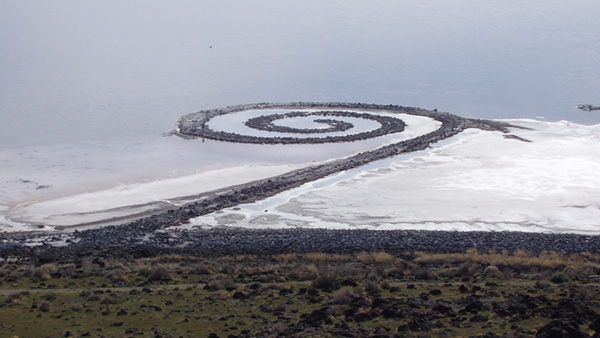
Spiral Jetty, created by Robert Smithson in 1970, stands as a monumental example of Land Art, elegantly illustrating the harmonious interaction between human-made structures and the natural landscape. This iconic earthwork, a vast coil unfurling into Utah’s Great Salt Lake, demonstrates how geometric shapes can assume new meanings when integrated with their surroundings.
Much like aeroglyphs, which use the sky as a canvas for ephemeral light patterns, Spiral Jetty interacts dynamically with its environment—the changing water levels and light conditions continually altering its appearance and interpretation. Both forms of art, despite their differences in medium and scale, share this transformative quality, where the artwork and its setting engage in a fluid, ever-evolving dialogue, highlighting the transient yet impactful nature of such creations.
Land Art, Aeroglyphs, and Site Specificality
Aeroglyph photography and Land Art, fall into yet another creative category of Site-specific installations. Site-specific installation is an art genre where the artwork is created to exist in a certain place, often forming an interdependent relationship with its location. The work is designed to engage with its surroundings, taking into account the history, culture, environment, and aesthetic of the space. It’s not merely placed in a location, but is conceptually bound to it, often becoming inseparable from its context.
In the realm of aeroglyphs, this concept manifests distinctly. These creations are not just in the sky; they are of the sky. Their execution depends entirely on the spatial and temporal characteristics of their aerial environment. They engage with the vastness, openness, and the ephemeral nature of the atmosphere, making them quintessential examples of site-specific installations.
Both Aeroglyphs and traditional Land Art also challenge traditional notions of canvas and gallery, taking art out of confined spaces and integrating it into the larger world. This integration not only broadens the audience for these works but also invites viewers to reconsider their relationship with the natural world. In Land Art, the terrain becomes an integral part of the artwork, just as the sky becomes the canvas for aeroglyphs.
The role of photography in both aeroglyphs and land art is pivotal, especially considering their fleeting existence. In many cases, the photographic image serves not just as a documentation but as the primary representation of the artwork itself. For aeroglyphs, which are often only fully visible through long exposure photography, the image captures a momentary event, a transient interaction between light, technology, and the landscape of the sky. It’s through this medium that the artwork is fully realized and communicated to an audience.
Similarly, land art, often situated in remote or expansive locations, relies on photography to capture and convey the scale, context, and detailed nuances of the installation. The photograph becomes a bridge between the artwork and the viewer, providing a lens through which these site-specific creations can be experienced, even if only as a representation.
In both cases, the photographic image transcends simple visual recording. It becomes an integral component of the artwork, a necessary medium through which these temporary and site-specific events are communicated, understood, and preserved.
Creating Light-Based Aeroglyphs: The How-To
The creation of light-based aeroglyphs often requires specialized equipment such as high-intensity lights or drones fitted with LED lights. Preparing a detailed flight plan using GPS technology is crucial for precision. Pilots or drone operators follow the pre-determined path, with the lights creating a continuous visual line in the sky. Timing and synchronization are key, as the formation of the image depends on the movement and the illumination of the lights.

Without access to sophisticated equipment like planes, GPS, or high-end drones, creating light-based aeroglyphs might seem challenging. However, there are still ways to engage in this art form using more accessible methods.
- Simple Drone and Lights: Utilize a basic consumer drone equipped with a small LED light or a series of lights. While this won’t allow for the creation of highly intricate designs, you can still produce compelling geometric shapes or simple symbols.
- Long Exposure Photography: Pair your drone’s movements with long exposure photography. By setting your camera to a long exposure setting and capturing the path of the drone’s lights against the night sky, you can create the illusion of an aeroglyph.
- Collaborative Efforts: Organize a group of individuals with small drones, each equipped with a light. By coordinating the movement of these drones, you can create larger and more complex designs. This method requires careful planning and practice to synchronize the movements.
- Kites with Lights: For a more low-tech approach, attach lights to kites and fly them in patterns against the night sky. While the control is less precise than drones, kites can add an organic quality to the designs.
- Light Balloons: Attach LED lights to helium balloons and release them into the sky. By controlling the release and the movement to some extent, you can form basic shapes or patterns. However, be mindful of environmental impact and safety.
- Model Aircraft: If you have access to model aircraft, attach lights to them and fly them in patterns. This method offers more control than kites and can be a step towards more complex designs.
Each of these methods requires creativity and practice. The key is to start with simple designs and gradually experiment with more complex patterns as you become more comfortable with the medium. Remember, the charm of light-based aeroglyphs lies in their creativity and the joy of creating something beautiful in the night sky, regardless of the complexity or scale of the equipment used.
Making Your Aeroglyph Stand Out
To make your aeroglyphs truly stand out, infusing it with personal significance is key. By embedding personal or cultural symbols into your design, your aeroglyphs become more than just a visual spectacle; they transform into narratives or messages that resonate on a deeper level with you and potentially with your audience. Additionally, incorporating elements that are local to the environment where the aeroglyph is displayed can significantly enhance its relevance and impact.
Consider the unique skyline, historical context, or notable landmarks of the area to forge a meaningful connection between the art and its surroundings. Furthermore, pushing the boundaries with innovative design choices—playing with an array of colors, varying intensities, and dynamic motion—can elevate your aeroglyph. This approach ensures that your creation not only captures attention but also leaves a lasting impression in the night sky.
A Lasting Impression
In summary, the art of aeroglyphs in photography represents a captivating convergence of traditional aerial techniques and innovative light painting. These ephemeral sky etchings, pioneered by artists like Reuben Wu, not only showcase a breathtaking interplay of light and technology but also echo the principles of land art and site-specific installations. They transform the sky into a dynamic canvas, where each creation becomes a temporal dialogue between art, technology, and the environment.
This evolving art form, embracing the unique blend of personal significance and environmental integration, stands as a vivid reminder of art’s limitless potential and its power to connect us with the world in profound, unexpected ways. Aeroglyphs, in their luminous splendor, challenge us to look upwards and find inspiration in the boundless night sky, inviting us into a world where art transcends traditional boundaries and ignites the imagination.


