

Last Updated on January 28, 2025
Table of Contents
What is Figurative Art?
The timeless practice of figurative art continues to hold a pivotal place in the art world, bridging the past with the present and future. Central to this enduring tradition is the work of dedicated artists and educators who not only pursue their own artistic visions but also mentor the next generation, fostering skills, passion, and a deep appreciation for the craft.
In the context of visual art, specifically painting and drawing, figurative art refers to works that depict recognizable subjects from the real world, with a significant focus on the human body. This genre of art aims to represent form and figure based on visual observation, capturing aspects of reality while often imbuing them with emotional, social, or conceptual depth.

Unlike abstract art, which eschews direct representation in favor of conveying emotion or ideas through non-representational forms, figurative art maintains a clear connection to the physical world, offering interpretations of human figures, landscapes, objects, or scenes that viewers can identify and interpret based on their resemblance to the real world.
But while rooted in the physical world, figurative can also be abstract, incorporating expressive techniques like exaggerated forms, distorted proportions, or stylized features to convey deeper meanings or emotions. This blend allows for a diverse expression within the bounds of figurative art.
The human figure, as a central motif in figurative art, serves as a powerful vehicle for expressing the myriad facets of human experience, making figurative art a perennially relevant and compelling genre within the broader visual art fields of painting and drawing.
Interview: The Figurative Painting of Rima Jabbur
Rima Jabbur has carved a distinct niche for herself in the realm of figurative painting, a testament to her profound engagement with the human form and her unwavering commitment to exploring the depths of human expression. With a career that spans several decades, Jabbur has not only contributed significantly to figurative painting through her own works but has also played a crucial role in shaping the artistic journeys of numerous students.
Her teaching philosophy, rooted in the belief that mastering the art of figurative drawing is a fundamental step towards a broader artistic exploration, has encouraged students to not only develop their technical abilities but also to cultivate a deeper understanding of their subjects.
It’s this philosophy that has made her classes a transformative experience for many, including myself. From a personal vantage point, Rima Jabbur has been more than an instructor; she has been a mentor, guiding me through the nuances of art and encouraging me to pursue my passion relentlessly.
In this interview, we delve into the mind of Rima Jabbur, exploring her inspirations, her approach to the intricacies of figurative work, her invaluable advice for young artists embarking on a journey in figurative art, and her insights on the role and significance of figurative work in today’s art world.
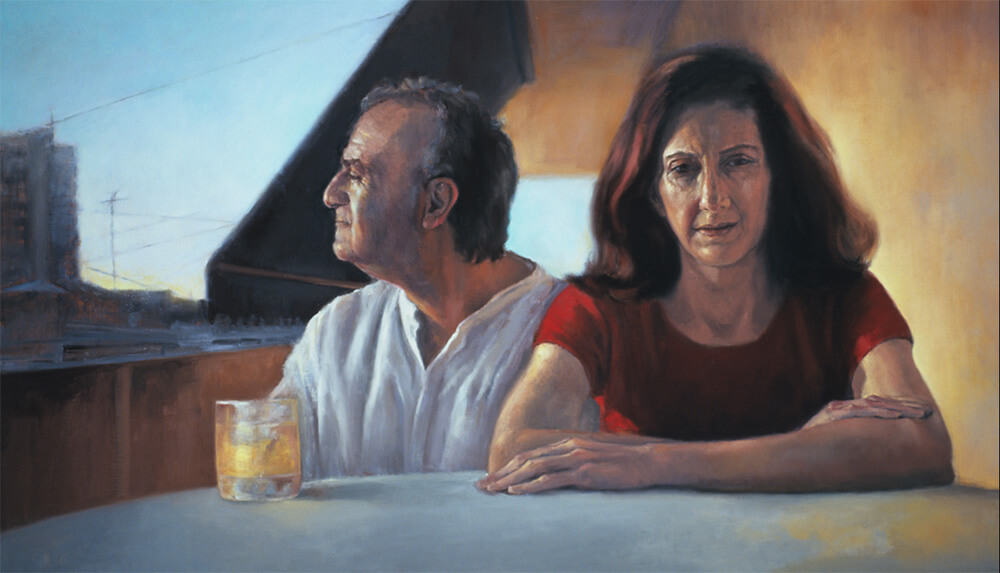
Through her eyes, we glimpse the passion and dedication that drive the creation of impactful figurative art and the profound lineage of influences in figurative art that shapes future generations of artists.
How did you become interested in figurative painting?
It all began with portraiture.
I took a drawing class at Cornell with Zevi Blum. He had an analytical approach, not so much concerned with precision as he was with the expressive potentials of distortions and the mood conveyed.
It had to do with the psychological impact, the inherent design decisions, and the line quality of the drawing. Something in my drawings intrigued him, and this in turn made me see myself differently.
I was “the visitor from the philosophy department”, which was my major. Cornell, despite its size, had a small art department, and it felt insular.
Which artists or movements have influenced your approach to figurative painting?
I was always attracted to classical Italian painting of the Renaissance and Baroque, but I also liked edgy, darker artists like Egon Schiele and Diane Arbus.
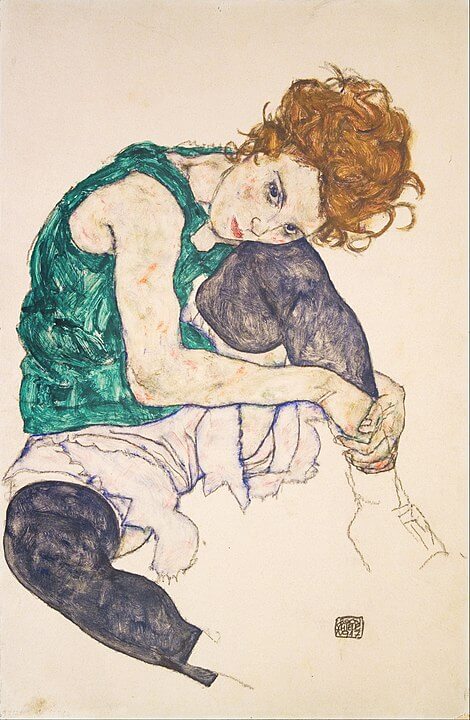
Eventually, I moved to Berkeley, California, and continued to study philosophy while I took a few more studio art classes. The studio classes felt unstructured and lacked a sense of purpose that I could make sense of.
I even took two painting classes with abstract expressionists at the SF Art Institute. I received no instruction, which threw me back on myself in ways that left me confused.
I then moved to Baltimore to be with my husband, and I applied to Johns Hopkins University for a PhD in philosophy. While waiting to hear a response, I enrolled in a drawing class at Md. Art Institute, College of Art (MICA), which had a very strong foundation program in painting and drawing. Despite getting into the philosophy program, I continued at MICA with the encouragement of Abby Sangiamo.
I settled on portraiture, life drawing, and landscape drawing. In painting, I preferred interior spaces without the figure because my figure painting was weak.
I was grateful for those structured MICA classes where I didn’t have to stand in front of a blank canvas and just suffer. Surprisingly, I found that perceptual painting and drawing carried enough meaning for me, and it wasn’t just in the choices of subject matter.
In the process itself, I could project my unconscious thoughts onto the paper or canvas. Things and places would take on symbolic meaning with which I found myself in conversation. Is this madness?
I was never drawn to pure abstraction because it felt so arbitrary and meaningless. It seemed like playing with shape, color, and line for the sake of design.
I knew that I didn’t understand where it was coming from. Still, this did not prevent me from being attracted to the gestural freedom of DeKooning or the fluid paint application of Cecily Brown, both of whom are still pretty figurative.
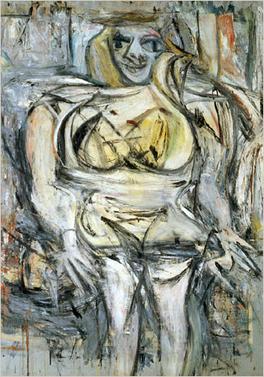
In graduate school, I still couldn’t paint the figure convincingly, so I painted interiors and architectural spaces.
Occasionally, I would lift figures out of stills from film, and random images I found in magazines. An instructor once yelled at me and questioned my integrity for doing that.
I then began using Eadweard Muybridge’s references of figures and animals. I figured if Frances Bacon could, why couldn’t I?
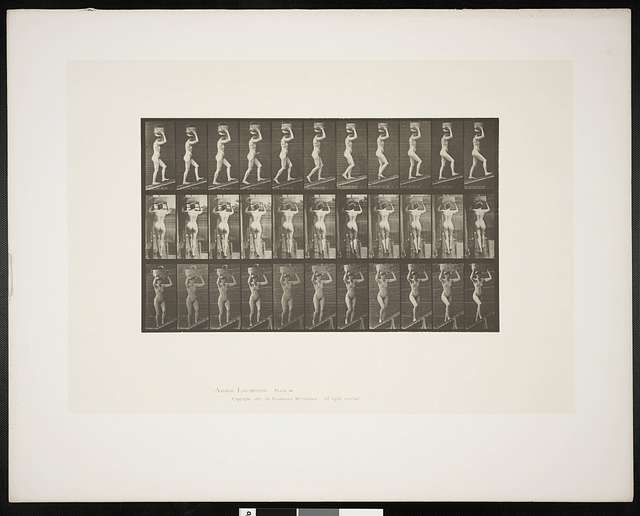
At this point, I was painting weird, surreal images in which I was trying to get at something between a dream space and an inner mood. There were probably some latent mythical, archetypal images and symbols in there.
What is the difference between a portrait and a figurative painting?

I think of the focus in portraiture as having to do with individual character. A figure painting could be more impersonal, with the emphasis on the sitter and the context or space.
Sometimes a figure painting is just that – an opportunity to paint a sensual body and life-like skin.
Can you describe your process when starting a new work of figurative art?
I begin a painting by doing measurements so that there’s no unwanted cropping. I generally like the figures to be about life-size. After putting down an initial drawing, I would start with a monochromatic, tonal underpainting.
Recently, I’ve been starting with a chromatic grisaille. I found that this gives me the best and quickest overview of the painting as a whole. It establishes temperatures and values without having to be too precise. I use a limited palette of broken tones ( a complimentary pair), mixed with lots of white, so that the initial layer of the painting looks very washed out.
Then, I gradually add more and more chroma while tightening up the drawing.
I find this approach helpful with large canvases because you can get a feel for the whole surface early into the process. It makes a large canvas less overwhelming while keeping the painting quite flexible and loose.
How do you approach the challenge of capturing the human form?
Before I began to have a handle on painting the figure, I did large (life-size), pastel drawings. I thought that a dry medium would be easier for me than paint. Since I could draw, then maybe this was how I should approach the figure in order to introduce color and texture.
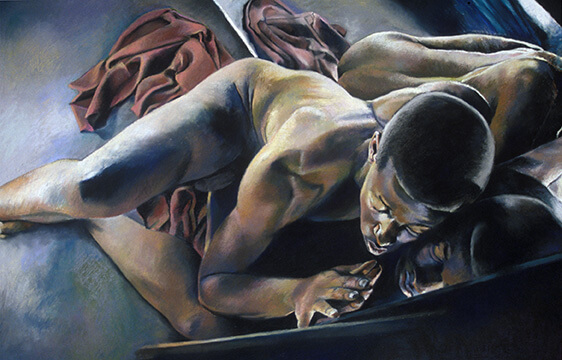
I was able to get some beautiful layering with pastels, but the drawings were vulnerable and costly to frame and ship around. Also, spraying fixatives diminished their layered complexity.
It was at this time that I decided to study with Odd Nerdrum because his surfaces were so rich and layered.
They seemed to have all the qualities that I wanted to acquire. Now, I begin a figure with a line drawing, and I begin the layering process from there.
I want the figures to be as three dimensional as possible, and I want the figure to sit in the space, not on it.
This illusion has to do with such things as handling the edges of the figure’s contours, convincing modeling of the form, and observing how the overall color of the space the figure is in affects the colors in the figure itself. These are considerations that all naturalistic painters have to think about.
I use photographic references (my own mostly), and I find that at some point it’s important to abandon the photo in order to go beyond it.
What are the key skills you believe are essential for mastering figurative painting?
Drawing the model from life repeatedly, anatomical studies, and copying old master drawings are the best ways to learn to draw the figure convincingly.
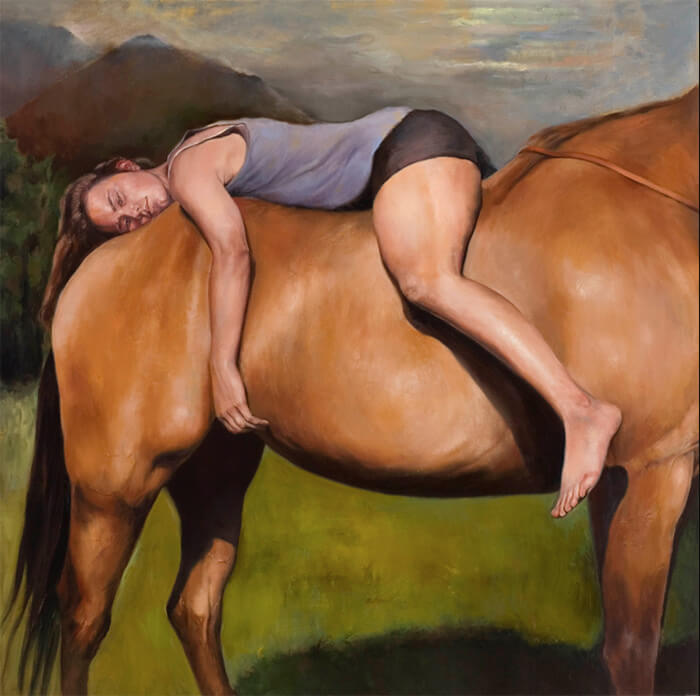
Having to look closely at the underlying structures of the body (musculature and skeleton), gives you a visceral understanding of the human form. This translates into your figure drawing more and more.
What does figurative art represent to you?
Since it all began with portraiture drawing for me, the idea of seeing a person come to life on a 2D surface still holds a fascination for me. I find that a narrative of sorts begins quickly from there.
The context of the model (the space they occupy, the pose itself, the light, the props if any) contributes to the narrative. Two or more figures immediately set up a narrative of relationships. Storytelling expands the narrative if there is the suggestion of an event, implying the passage of time.
There’s almost no such thing as a straight forward portrait.
A photographic snapshot can be just that, but not a painting. Painting involves too many decisions to be straightforward. Figure and portraiture paintings tell us about the artist and the time in which he/she lived.
Today there are many impressively skilled painters coming out of traditional ateliers, whose work seems to be coming out of the past in every sense. They believe that their work is ‘timeless’. It’s a kind of hopeless nostalgia that I find depressing.
On the other hand, many good painters use these acquired skills as a stepping stone for their own development as artists. There really has to be something in the work that has a contemporary context.
There is ‘the unknown’ part of the painting process that becomes interesting for an artist’s self-awareness. We discover, in the process of painting itself, that which drew us to a certain subject. We are pulled to it because we have an intuition that there is something to draw out of that subject that could be enlightening and fresh.
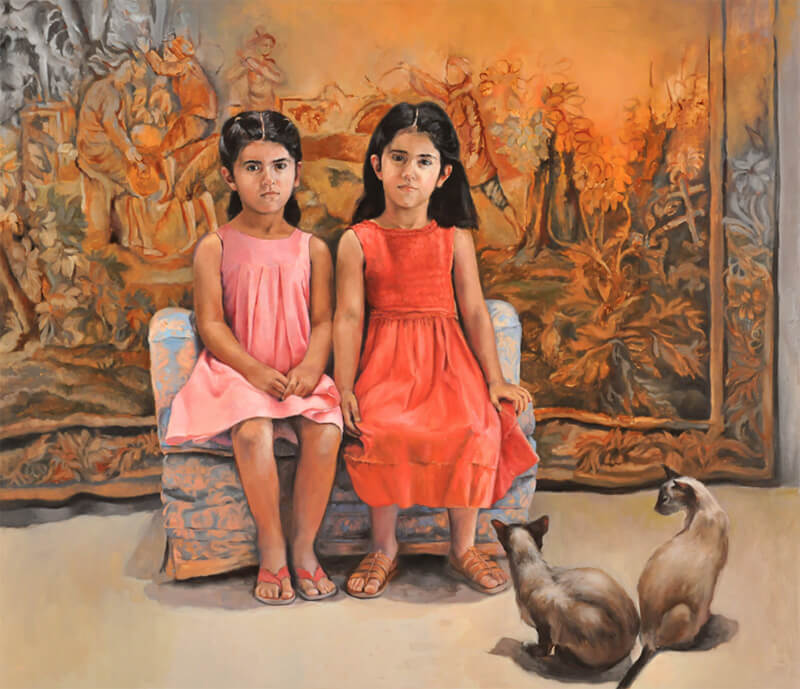
The original starting point of a painting can become quite obscured as the painting is developed. It can even change, though the seeds of the original idea are still in there somewhere. I’ve always liked what Frances Bacon said about his painting process, that “you have to beguile yourself” while painting. If you already know the outcome, it becomes a task with a predictable result. This is not to say that there isn’t a certain ‘nose to the grind’ element involved.
Once the painting is out in the public, the artist has no control over how it will be received. Ideally, you want to get the viewer’s attention and to hold it for as long as possible.
There’s nothing wrong with using seductive beauty, tantalizing color, jolting juxtapositions, etc, all within the parameters of your personal sensibilities. The success of a painting involves so many elements that have to operate harmoniously with each other, on their terms.
How do you balance realism and abstraction in your work?
A good abstract design is present in a well-designed representational painting. It has to do with the layout.
Good design is intuitive, and the initial layout contributes to the meaning and feeling you want to convey.
This includes scale, horizontal or vertical orientation, stability or instability of design (static or in motion), and handling of color.
In addition, you have to consider how you want the viewer to move through the space. Abstract doesn’t just mean non-representational. You can also bring the eye to the surface in a painting, by introducing a flat or abstracted area. Here a painter could be making a reference to an abstract movement.
How have you seen figurative painting evolve over the course of your career?
All representational paintings (figurative, landscape, portraiture, etc.) are in a great place today. In recent years, it has seen a huge resurgence in popularity and interest.
Back in the 80’s when I attended art school, it was totally passe, and only a few gallerists were interested in it (figurative style painting).
There were always a few figurative painters who were successful even back then, such as Eric Fischl, Lucien Freud, and Antonio Lopez Garcia who began what I think was called the Madrid School. There were many others as well.
My list of contemporary figurative painters I admire is pretty long. It includes Jenny Saville, Zoey Frank, Vincent Desiderio, and Bernardo Siciliano. Lots more too!
Today figurative painting is very robust, and it’s going strong.
Feature Image (above) by Rima Jabbur. After Igres, 1999. Oil on Canvas. Courtesy of the artist.


