

Last Updated on June 30, 2025
The Art of Art Conservation
We often think of art as immortal. A painting in a museum, a sculpture in a public square, a minimalist installation on a pristine white plinth—each seems to defy time, quietly announcing: I will be here long after you’re gone.
But the truth is, art is rarely made to last forever. The illusion of permanence is part miracle, part maintenance—and often, a race against time.
This became especially clear to me while visiting the Museum für Konkrete Kunst in Ingolstadt, where a current exhibition, In Preparation. Die Ausstellung, deals exclusively with the challenges of conserving works made from impermanent materials such as industrial paints, modern plastics, and time-sensitive adhesives. Though the focus is on form and purity—line, color, space—the invisible drama happening behind the scenes is one of restoration labs, climate-controlled storage, and the ticking clock of physical decay. This article is a natural follow-up to my earlier piece, What Is Concrete Art?, also inspired by this visit—where the clarity and precision of Concrete Art meet the messy, material realities of time.
Why We Imagine Art is Immortal
There’s something poetic—and perhaps comforting—in believing that great art transcends time. We speak of the “eternal” value of masterpieces and of artists “living on” through their work. Museums, with their quiet authority, reinforce this idea: they preserve, protect, and present artworks as if they’ve always been here and always will be.
But this myth of immortality clashes with reality when we look closely at materials. Paint fades. Metals corrode. Adhesives fail. Even the most carefully constructed installation is vulnerable to time, light, and touch.
Interestingly, even ephemeral art, which deliberately embraces impermanence, doesn’t entirely escape the pull of immortality. As I explored in Ephemeral Art in the Light of Heidegger, there’s a philosophical paradox at play: though the physical artwork may vanish, its truth—its idea, impact, or poetic resonance—can endure. In this way, ephemeral and permanent art aren’t opposites, but different expressions of the same desire: to touch something beyond the moment.
Art conservation, then, is not only about holding onto materials. It’s a way of safeguarding access to meaning, even as the physical world proves unreliable. Whether a piece was meant to last or meant to vanish, we still seek a way to remember it—and perhaps, in remembering, keep it alive.
What Is the Lifespan of Art?
Every medium tells a different story—not just about how a work was made, but how long it might survive.
- Oil paintings, when properly maintained, can last for centuries. Some of the oldest surviving works, such as 15th-century Flemish panel paintings, still display remarkable depth and vibrancy. But oils are fragile beneath the surface. They’re vulnerable to humidity, which causes canvas to expand and contract; to light, which can fade pigments; and even to vibrations, which over time lead to the formation of cracks. Old master paintings often undergo careful relining and consolidation to slow the inevitable aging of the paint film.
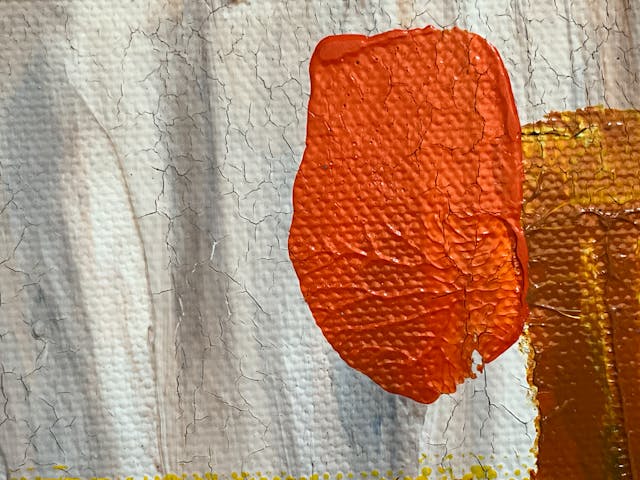
- Acrylics, introduced in the 1930s and popularized in the 1950s and ’60s by artists like Helen Frankenthaler and David Hockney, were initially heralded for their flexibility and quick drying time. But many early acrylic works now show cracking, flaking, or discoloration. The paints are thermoplastic, meaning they soften with heat and harden in cold, making them vulnerable to climate fluctuation. Their porous surfaces attract dirt, and since they were often left unvarnished, damage and grime can become embedded over time. Conservation labs today wrestle with how best to clean or restore these surfaces without altering their appearance.
- Photographs, particularly color prints and instant film like Polaroids, are among the most fleeting mediums. Color dyes fade quickly, often within a few decades, especially if exposed to light or stored in non-archival conditions. Black-and-white photographs printed on fiber-based paper fare better, but even they are subject to silver tarnishing, paper warping, or chemical residue if not properly processed. Preservation depends on controlled humidity, darkness, and sometimes digitization to retain the image even as the original fades.

- Plastic-based works, common in Pop Art and Minimal art, pose some of the most pressing conservation problems. Artists like Claes Oldenburg or Donald Judd often used materials like PVC, acrylic glass (plexiglass), and polyurethane foams—materials that were never designed for longevity. Over time, these plastics can become brittle, sticky, discolored, or exude harmful gases. In some cases, the chemical degradation is irreversible, and conservators must make the difficult decision of whether to replace components or let them deteriorate in place.
- Conceptual and installation art adds an entirely different challenge. These works often include ephemeral or perishable materials, like paper, plants, food, or even sound and light. What’s being preserved isn’t always a physical object but an idea or experience. In such cases, art conservation involves documentation, artist interviews, and re-creation guidelines. For instance, Félix González-Torres’ “candy spill” installations can be replenished indefinitely, while other pieces, like those of Eva Hesse, are left to decay as an intentional part of the work’s meaning.
In short, art is far more mortal than we like to think. Even with the best materials and intentions, time leaves its mark. Art conservation is often less about preserving the object forever, and more about delaying the inevitable—gracefully.
The Hidden Challenges: Storage, Shipping, and Human Touch
Art doesn’t just age—it also travels. Every time a piece is loaned for an exhibition, the risk of damage increases.
- Transport is one of the biggest stressors. Even in custom-built crates with shock absorbers, changes in air pressure or rough handling can do damage.
- Storage can be more dangerous than display. Works stacked in warehouses, no matter how carefully, are vulnerable to temperature shifts, pests, and forgetfulness.
- Visitors, with their good intentions and greasy fingers, leave behind invisible fingerprints that over time damage delicate surfaces. The most common conservation problem? Handprints.
And then there’s the emotional toll: a work created decades ago begins to crack, yellow, or warp—and curators must decide whether to restore it, let it age naturally, or recreate it entirely.
Preservation in Practice: Two Case Studies from Ingolstadt
The exhibition In Preparation. Die Ausstellung at the Museum für Konkrete Kunst doesn’t just present finished works—it foregrounds the hidden vulnerabilities artworks face over time. Two standout examples from the show illustrate the wide-ranging and often unexpected conservation issues that museums must navigate.
Exhibit A: Wilhelm Koch, Untitled
A large wall-mounted sculpture by Wilhelm Koch draws attention immediately with its inflated rubber form—soft-edged, minimalist, and undeniably tactile. The temptation to touch it is apparently overwhelming: the surface is covered in visible fingerprints, evidence of repeated contact by viewers.

But this is more than an issue of etiquette. The rubber itself is highly sensitive to oils, dust, and light. Over time, it loses its characteristic shine, becoming increasingly dull and brittle. In addition, the piece’s air-filled construction requires careful monitoring of internal pressure and seal integrity—too much or too little tension could deform the entire structure.
What looks simple and serene on the wall is, in fact, a highly vulnerable and maintenance-intensive object—its visual impact dependent on preserving its material freshness, despite forces actively working against it.
Exhibit B: Atelier Strube
In a neighboring gallery, a framed print by Atelier Strube tells a quieter but equally urgent conservation story. A striking geometric composition made from black cutouts on a cream-colored backing board reveals distinct signs of water damage, visible as discolored edges and subtle warping along the bottom.

On closer inspection, the mounting method becomes part of the problem: double-sided adhesive tape, long since degraded, is no longer holding the work securely in place. This not only risks further physical movement and damage, but also complicates future restoration. Removing aged adhesives can threaten the artwork’s surface and require painstaking treatment to stabilize.
This example reminds us that even small technical decisions—like what tape to use—can carry long-term consequences for a work’s survival.
The Philosophy Behind Restoration
In 2012, a well-meaning octogenarian in Borja, Spain, made international headlines for her botched attempt to “restore” Ecce Homo, a fresco of Christ painted a century earlier by Elías García Martínez.

The result—a distorted, almost cartoonish face dubbed “Beast Jesus”—sparked outrage and ridicule, but also a surprising second life for the work. Pilgrims and tourists came in droves. Some argued that the damage became part of the work’s meaning. Others saw it as an irreversible loss.

This bizarre episode raises a deeper question: When does damage become part of an artwork—and when does it simply destroy it?
Restoration isn’t just about fixing—it’s about choices. Sometimes, conserving an artwork involves accepting wear and tear as part of its narrative. In other cases, those marks of age threaten to undo the artist’s intent entirely.
- Should a cracked minimalist sculpture remain cracked if the rupture complements the aesthetic? Or should it be seamlessly repaired to preserve the original geometry?
- Should fingerprints on a polished surface be left if they speak to the public’s interaction with the piece? Or do they obscure the artist’s chosen finish?
- When an artwork was meant to be ephemeral—like many conceptual or installation pieces—does re-creating it for a retrospective violate its authenticity, or fulfill the artist’s intention?
These aren’t just curatorial questions—they’re philosophical. They ask: What is art really made of? Is it the physical object? The original concept? The artist’s intention? Or the journey it takes over time, including accidents and decay?
There are examples where damage has become part of the work. Think of Lucio Fontana’s slashed canvases—once radical acts of destruction now frozen into celebrated form. Or Eva Hesse’s sculptures, many of which are deteriorating due to her use of unstable materials. Conservators often choose to let them disintegrate, believing that this fragility is part of the work’s meaning.
But this cannot apply to all cases. If a neon installation shorts out, or a video work corrupts, we don’t say the artwork has “evolved”—we say it’s broken. And when color photographs fade to murky orange due to poor processing, the intended tonalities are lost.
This is where art conservation becomes not only important but ethical. It’s not about clinging to the past—it’s about honoring the artist’s vision, keeping the work intelligible, and ensuring that its message can still be experienced. The challenge lies in deciding when intervention preserves meaning, and when it risks rewriting it.
In the end, restoration is less about bringing art back to life and more about keeping it legible in time. It’s the quiet stewardship of both form and idea—and a recognition that while art may not be immortal, it can be cared for, so that future generations encounter it as more than just a ruin.
The Future—and Fragility—of Art Conservation
As artists increasingly embrace unconventional materials—LED lights, digital projections, living plants, bio-based plastics, even AI-generated content—the demands on art conservation are evolving rapidly. Museums and galleries now face the daunting task of preserving not just traditional media like bronze and oil, but also software code, tape loops, ephemeral installations, and data-dependent works that may one day become unreadable or obsolete.
The future of art conservation will require more than just technical innovation—it will demand interdisciplinary collaboration between curators, conservators, programmers, engineers, and, crucially, the artists themselves. For many newer works, the artist’s intent becomes the primary guide, especially when materials are meant to degrade or be replaced.
But behind it all, institutions like the Museum für Konkrete Kunst, with its focus on form and precision, quietly remind us how much effort is invested in maintaining the illusion of permanence. Behind every crisp white wall and polished surface is an invisible ecosystem: climate monitoring systems, conservation labs, registrars, and archivists working to delay the inevitable march of entropy—with cotton gloves, microfiber cloths, and terabytes of documentation.
And yet, art may never be truly timeless. It breathes, ages, changes—like us. What gives it power is not the false promise of immortality, but the care we take to steward it forward. Preservation becomes an act of devotion. The cracks, the fading, even the replacement parts—all become part of the work’s story.
So the next time you find yourself in a gallery, standing before something quietly radiant, take a moment to consider not just what you’re seeing, but everything keeping it visible: the decisions made, the risks taken, the conservators’ touch, and the institution’s commitment to bridging the past to the present.
Feature Image Photo Credit: Photo by Israyosoy S.


