

Last Updated on January 28, 2025
Table of Contents
Mathematics and Art: A Match Made in Heaven
Why does mathematics resonate so profoundly with art? The answer lies in the universal language of mathematics—a language of symmetry, proportion, and harmony. These are not just abstract concepts but are fundamental to the way we perceive and interact with the world. In art, these mathematical principles become a bridge, connecting the tangible reality with the intangible realms of creativity and emotion.

Mathematics, in its essence, is about finding patterns, defining order in chaos, and exploring the relationships between shapes and forms. Artists like Hilma af Klint and M.C. Escher tapped into this rich vein of knowledge, using it to bring a deeper level of understanding and connection to their work. They recognized that math is not cold or impersonal, but rather, it embodies a kind of beauty that speaks to the soul. It’s a beauty found in the perfect spiral of a seashell, the symmetry of a snowflake, and the intricate patterns of a spider’s web—natural art forms that are mathematical at their core.
By incorporating mathematical elements into their art, these artists remind us that math and art are not separate entities but are interconnected facets of human understanding. They show us that mathematics is not just about numbers and equations, but about finding a rhythm in the chaos, a pattern in the random, and a harmony in the disparate. This interplay creates a resonance that is both intellectually stimulating and emotionally evocative, inviting viewers to explore the deeper meanings and connections that lie beneath the surface.
Painting with Numbers
How are Art and Math Related?
Art and math are deeply interconnected in several ways, demonstrating how these seemingly disparate fields can complement and enrich each other. Here are some of the key relationships between art and math:
- Geometry and Perspective: Art often utilizes principles of geometry, such as shapes, symmetry, and perspective, to create compositions that are visually pleasing or realistic. Renaissance artists like Leonardo da Vinci and Brunelleschi applied mathematical principles of linear perspective to create the illusion of depth on a flat surface.
- Patterns and Symmetry: Both art and math appreciate the beauty of patterns and symmetry. Mathematical concepts of repetition, transformation, and symmetry are often explored in art forms such as Islamic tile work, tessellations in the work of M.C. Escher, and the intricate patterns found in indigenous art.
- Fractals and Chaos Theory: Fractals, which are complex geometric shapes that look the same at every scale, are a concept from chaos theory in mathematics. These shapes are not only visually fascinating but also appear frequently in nature, and artists have used fractal-like patterns to mimic nature and create abstract compositions.
- Golden Ratio and Aesthetics: The Golden Ratio is a mathematical ratio (approximately 1.618:1) that has been used in art and architecture to create compositions considered aesthetically pleasing. The ratio has been applied in the design of ancient structures, paintings, and even modern web design, suggesting a universal appeal to human perception of beauty.
- Digital Art and Computer Graphics: Advances in mathematics, especially in algebra and calculus, have enabled the development of computer graphics and digital art. Algorithms and computational geometry are at the heart of creating realistic textures, 3D models, and animations in video games, movies, and virtual reality.
- Algorithmic and Generative Art: Some artists use algorithms and computational methods to create art, known as generative art. This approach often involves programming computers to generate patterns, shapes, or even entire compositions, based on mathematical rules or randomness, resulting in works that are both unique and deeply rooted in mathematical logic.
At the intersection of mathematics and art lies a visual and technical confluence where the precision of numbers and the fluidity of artistic expression coalesce. This fusion manifests in the meticulous arrangement of shapes, the careful calibration of proportions, and the deliberate orchestration of patterns and symmetry.
This interdisciplinary creative approach allows artists to incorporate mathematical precision in their visual expression, and mathematicians to explore the aesthetic aspects of their formulas and theories. It’s a practical collaboration that enriches both disciplines, providing artists with new tools and perspectives, and offering mathematicians a way to visualize and conceptualize abstract concepts.
Here, the artist acts as both a mathematician and a storyteller, employing geometric principles to structure their canvas in a way that guides the viewer’s eye and evokes emotion. The mathematical underpinnings, often subtle and unobtrusive, provide a skeleton upon which the artistic flesh is layered.
This symbiosis is evident in the way a painter might use the golden ratio to achieve a composition that feels both natural and pleasing, or how a sculptor might harness fractal patterns to replicate the complex beauty of natural forms. In this realm, math does not constrain creativity; rather, it serves as a foundational language, allowing the artist to translate the abstract beauty of numerical concepts into tangible, visual forms that resonate with the deep-seated human instinct for order and harmony.
Sublimity of the Golden Ratio
The journey into the entwining of mathematics and art appropriately begins in ancient Greece with Pythagoras, a philosopher and mathematician who profoundly influenced the way we understand the world. Pythagoras and his followers believed in the profound interconnectedness of all things, a belief rooted in the observation of geometric principles found in nature. They posited that these geometrical forms and ratios were not mere coincidences but the building blocks of the cosmos, the underlying structure of reality itself.
Sacred geometry, the study of these divine proportions and patterns, became a cornerstone in understanding how the world is constructed and how it functions. This concept swiftly permeated the world of art, as artists sought to replicate the harmony and beauty found in nature. They recognized that by mimicking these geometric principles, their creations could evoke a sense of balance and perfection seen in the natural world. Thus, art became a medium to not only represent the physical appearance of nature but to capture its inherent order and symmetry.
One of the most famous and enduring concepts derived from this school of thought is the Golden Ratio. The Golden Ratio, approximately 1.618, is a proportion found in many natural forms—from the spirals of galaxies to the growth patterns of plants. In the realm of art, this ratio has been used to create compositions that are naturally pleasing to the eye. Leonardo da Vinci’s “The Last Supper” is a prime example, where the dimensions of the table and the arrangement of the figures align with the Golden Ratio, creating a sense of harmony and balance that draws the viewer into the scene.
Fibonacci Spirals
Building upon the concept of the Golden Ratio, the Fibonacci Sequence emerges as another fascinating example where mathematics and art intertwine, particularly through the Fibonacci Spiral. This sequence, a series of numbers where each number is the sum of the two preceding ones, starts with 0 and 1, and progresses (0, 1, 1, 2, 3, 5, 8, 13, …).

When these numbers are plotted graphically, they form a spiral that astonishingly echoes a myriad of naturally forming, organic patterns, from the arrangement of leaves on a stem to the spirals of galaxies. In the realm of art, this spiral provides a natural and aesthetically pleasing guide for composition, often used by artists to draw the viewer’s eye toward the focal point of a piece in a gradual, flowing manner.

Golden Triangles for Stunning Composition
Similarly, Golden Triangles are another mathematical concept that has found its way into the artistic domain, particularly in photography. A Golden Triangle is formed by dividing a rectangle into two right triangles with a diagonal line, creating dynamic and visually appealing compositions.

This technique allows photographers to create balance and tension within a frame, guiding the viewer’s eye through the image in a natural, flowing manner. When elements in a photograph, such as a road, a person, or a horizon line, align with these triangles, the composition becomes more dynamic and engaging. The use of Golden Triangles is not just a technical exercise but a way to tap into the natural patterns that our eyes find pleasing, creating images that resonate with the viewer on a subconscious level.
In conclusion, the journey from ancient Greece to the modern canvas and camera lens reveals a consistent truth: art seeks to mimic and recreate the harmonic principles found in nature. By understanding and applying mathematical concepts like the Golden Ratio and Golden Triangles, artists and photographers connect with these universal patterns, creating works that reflect the profound harmony of the world around us.
Escher’s Labyrinth: Navigating the Convergence of Mathematics and Art
M.C. Escher, a Dutch artist renowned for his captivating and mind-bending artworks, stands as a quintessential example of an interdisciplinary artist who seamlessly integrated mathematics into his creative process. Escher, initially more focused on traditional graphic arts, experienced a pivotal shift in his approach after exploring Alhambra’s intricate Moorish tiling, which ignited his interest in tessellation and symmetry. This encounter marked the beginning of his lifelong fascination with mathematical concepts, despite his lack of formal training in the field.

The tradition of Islamic art, particularly its intricate geometric patterns and designs, played a pivotal role in shaping M.C. Escher’s artistic vision. Islamic art’s intricate geometric compositions, deeply entrenched in the religion’s aniconic tradition, serve a dual purpose. Primarily, they adhere to Islam’s avoidance of figurative imagery in religious contexts, a reflection of the belief in the indivisibility and transcendence of God, who cannot be represented in physical form. This principle steers artists away from creating representational art, leading them instead toward geometric patterns that avoid any literal depiction of living beings.
Secondly, these geometric designs, rooted in mathematical principles, play a symbolic role. They are not mere decorations but are imbued with spiritual significance. The repeating patterns, interlacing motifs, and symmetrical arrangements found in Islamic art are more than just visually appealing; they are metaphors for the infinite, a reflection of the universe’s unending nature and the eternal presence of the divine.
Escher’s relationship with mathematics was largely self-taught, driven by intuition and visual experimentation. Specifically, he delved into complex areas such as Plain and projective geometry, which deal with the properties and relations of points, lines, surfaces, and figures. Plain geometry, also known as Euclidean geometry, focuses on these elements in a flat, two-dimensional space, emphasizing concepts like angles, distances, and the relationships between shapes.

Projective geometry, on the other hand, extends these ideas into a more abstract realm, considering how objects appear to change as they move within a three-dimensional space or when viewed from different perspectives. This branch of geometry is less concerned with the actual sizes and shapes of objects and more with their properties of alignment and relative position. This kind of hyperbolic geometry allowed Escher to create his famous optical illusions and impossible realities.
His iconic work, the “Endless Staircase,” exemplifies this blend of artistic vision and mathematical ingenuity. In the preliminary sketches for this piece, Escher outlined the basic concept of a staircase that loops back onto itself in an impossible loop. However, it was the mathematical refinement in his subsequent iterations that transformed the sketch into an optical marvel.

The significance of Escher’s “Endless Staircase” and later in his work “Relativity”, lies in its embodiment of the Möbius strip concept and the exploration of infinity within a confined space. It challenges viewers’ perceptions of space and reality, creating a visual paradox that cannot exist in three-dimensional space.
Harmonic Universe: Hilma af Klint’s Fusion of Art, Mathematics, and Mysticism
This section and the research behind it was inspired by a reader’s (C.H.) suggestion to explore Hilma af Klint’s masterworks in relationship to her ideas of cosmology and the subconscious. Luckily her scientific approach to drawing mixed her with hermetical investigations of reality make her work perfect for exploring the intersection of Art and Mathematics, as well as other mystical realms.
Born in Sweden in 1862, af Klint cultivated a deep fascination with the natural world, particularly botany, which led her to explore the intricate patterns and structures within nature.
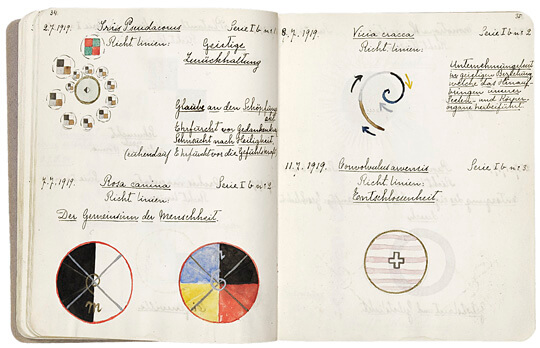
Her interest in art and mathematics was not just in its numerical or formulaic aspects but in its ability to reveal the underlying geometries that she perceived as sacred components of the natural world. In the booklet above we get a peek into her studies of geometries, spirals as in the Fibonacci sequence, and color relationships. This unique blend of interests laid the foundation for her pioneering abstract works.
Af Klint’s artistic trajectory took a pivotal turn as she delved into the realms of the occult and joined the Theosophical Society. This movement, which sought to blend mystical and philosophical traditions with a scientific understanding of the universe, resonated deeply with af Klint. It provided a framework through which she could explore her conviction that art could be a medium to express metaphysical and esoteric ideas.

In her monumental series “Paintings for the Temple,” af Klint’s work reflects a complex fusion of her interests in cosmology, mathematics, and spiritualism. Here, she uses geometric forms and symbolic color schemes to create compositions that are more than mere abstract expressions; they are visual representations of her understanding of a deeper cosmological order. For instance, the bands of visible light represent the building blocks of the material world which reaches transcendently towards the heavens.
Interestingly, her work also shows parallels with Freemason cosmology, which encompasses its own set of symbols, geometric principles, and beliefs about the mathematical underpinnings of the universe. Af Klint’s paintings, with their intricate structures and layered meanings, can be seen as visual counterparts to this cosmology, translating the Masonic and Theosophical philosophies into a unique artistic language.

Hilma af Klint’s work, as in her Paintings for the Temple series, stands as a testament to the multifaceted nature of art, where the physical, the metaphysical, and the mathematical intertwine. Through her art, af Klint sought to transcend the visible world, aiming to capture an essence of the universal truths that she believed were woven into the cosmos itself.
Conclusion
As an artist with a unique interdisciplinary approach, I have personally navigated the confluence of mathematics and art. At one point, I pursued dual majors in both fields, a testament to my deep-rooted fascination with their intersection. However, the demanding hours dedicated to mathematical studies in university posed a significant challenge to maintaining my art practice. Despite this, the insights and understanding gained from my involvement in mathematics have been invaluable to my artistic expression.
The discipline of mathematics endowed my creative impulses with a structured framework, particularly in the realm of geometrical compositions. The inherent logic of mathematics has also guided my creative process, allowing me to approach each art piece not just as a form of expression but as a theorem to be proved, a puzzle to be unraveled. This unique perspective has been instrumental in forging a meaningful dialogue with my work, enriching both the creation and the interpretation of my art.
In closing, the journey through the realms of mathematics and art is not just an exploration of two disciplines; it is a testament to the boundless potential of the human mind to find harmony in diversity, to build bridges across different modes of thinking, and to create profound beauty from the interplay of structure and imagination. Whether in the sweeping curves of a painting or the precise lines of a mathematical proof, the fusion of these realms continues to inspire and challenge, reminding us that in the vast canvas of human knowledge, every stroke of genius is a blend of calculation and creativity.
Thanks again for reader suggestions which contributed directly to this article. Feel free to contact me with any further suggestions through the comments or the contact form on this site.


